How AI Changed the Way I Read
My reading time hasn’t decreased. It has become hybrid.
AI has definitely disrupted the way I read in 2025 and 2026, while overall I haven’t spent less time reading. The closest word I have for the change is hybrid. AI is part of how I take in information and news now, while reading and thinking without it have become more important to me. I don’t think this is a simple change, and I’m still trying to understand what it truly asks of me.
It would have been easier to describe the change as a matter of efficiency: more information, less time. That doesn’t describe my experience very well. The question I care about is what happens to my own thinking and decision-making as AI becomes part of reading. How much am I understanding for myself? How much am I accepting because an answer is already there? Those questions matter even when the help is just right and useful.
Right now, I feel that I need deep reading and deep thinking more than ever. There is a real concern behind that feeling: if I keep delegating thinking to AI, or eventually to SI, will my own ability to think become weaker? I can’t predict how this will play out, but I don’t want to ignore any possibility.
A recent Anthropic study gives me another way to think about this concern. In a statistical analysis task, experts’ choices often followed their AI agent’s preferences, even when they felt the judgment was their own. Among the 50 analysts who used AI, 86% of their choices across four analytical decisions matched the agent’s randomly assigned preferences. The researchers deliberately strengthened those preferences to measure their influence, so I wouldn’t assume the same effect in everyday reading. The study doesn’t establish cognitive decline or test whether no-AI time helps. What feels relevant to my reading is the possibility of taking in a model’s judgment without noticing where my own begins.
So I consciously block out no-AI time for exploration and reading. I want there to be space where I don’t immediately turn a question over to a model. A question can stay with me for a while. I can read, try to understand, and leave room for my own reasoning before asking for another perspective. That time matters to me alongside the parts of reading where I do use AI.
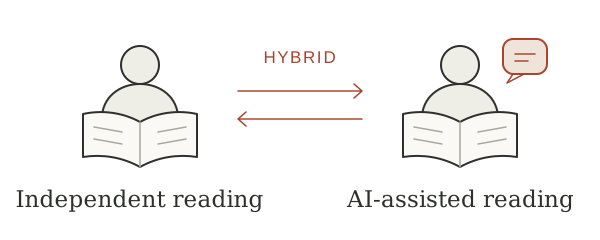
I don’t know whether this balance will stay stable. For now, I’m paying attention to the choice and set up a naive isolation: when I want help taking in information, and when I want to stay with the reading myself. I want to keep making that choice consciously rather than treating every opportunity to delegate as a reason to do so.
My efforts: Curator
Personal Curator started with a simpler frustration: sometimes I felt I was spending too much time reading news. On some weekends, I could spend three or four hours just reading through things. With Curator, I want to set a daily budget of about 40 minutes for a quick overview of the news and different market perspectives. It has helped me some already, especially with the urge to keep reading repetitive coverage. I’ll inevitably miss things, and that’s a trade-off I’m willing to try. I haven’t kept adding features, either. I don’t enjoy overengineering it.
The idea is still fairly modest: help me absorb, compress, and bring together information from many sources, including different perspectives. That gives me a starting point for deciding what deserves more attention. Gathering those views is useful, but I still need to weigh them and decide what I think. I see Curator as support for that work, and I’m still figuring out where it helps and where I need to do more of the reading myself.
Where Curator is meant to help
- Many sourcesDifferent arguments and perspectives
- CuratorHelp absorb, compress, and aggregate
- Human judgmentRead further · weigh evidence · decide
I want to keep the project close to that purpose, while making time to read deeply and think. Building Curator and protecting no-AI time both belong in the same experiment for me. I can’t predict where reading goes from here. For now, I want the help, and I want to keep doing the thinking.
References & notes
This essay draws on my own reading choices, not a measured study of AI’s effect on cognition. The figures illustrate the distinction I’m trying to preserve.
- Personal Curator — project notes. Background on the project discussed here.
- Amaç Herdağdelen, Hailey Joren, and Alex Tamkin. How AI agents shape experts’ judgment calls. Anthropic Research, October 27, 2026. An experiment on AI influence over expert decisions, with deliberately strengthened agent preferences.