Revisiting Situational Awareness
meaningful framework from the 2024 forecasts, what cheaper intelligence actually changes
I felt a bit ashamed that I actually first fully read Leopold Aschenbrenner's Situational Awareness in June 2026, two years after it came out, while I lived in Silicon Valley for years.
Well, after the disruption happened these years. I'm still shocked by looking into the lens in this paper that how much of the argument could be grounded in things we can count: compute, algorithmic efficiency, electricity, and capital.
infrastructure projections look remarkably close to reality. A roughly gigawatt-scale AI facility, once an extraordinary scenario, is now a useful comparison with projects being built and reported on today.
I wanted to revisit now with my personal salt about what held up, what remains uncertain, and a question I find increasingly interesting: as intelligence gets cheaper, what actually becomes worth building?
Start by counting the orders of magnitude
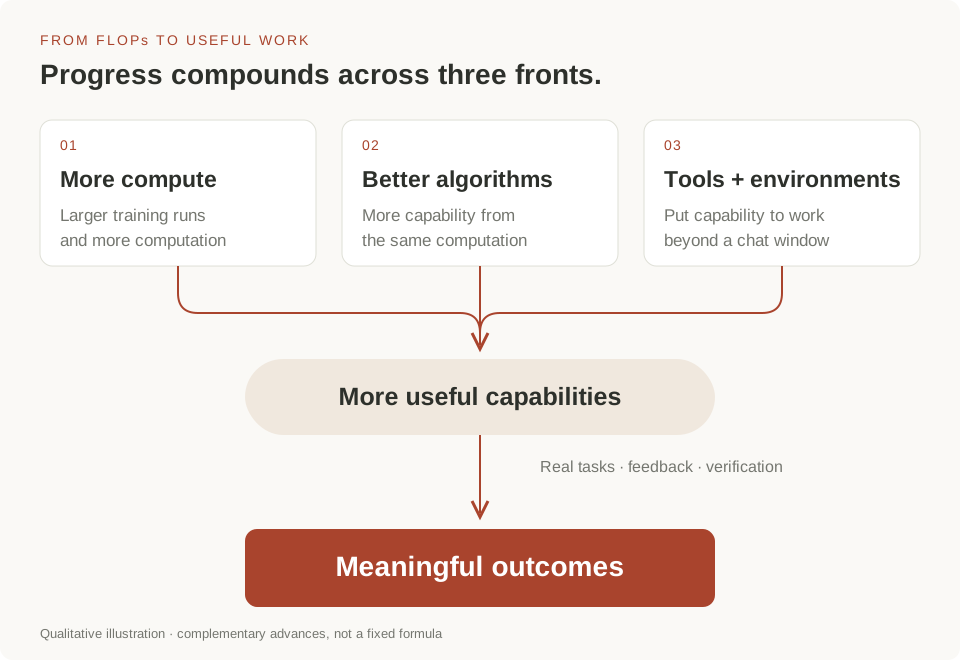
Aschenbrenner’s “Counting the OOMs”, where each OOM is a tenfold increase, separates progress into physical compute, algorithmic efficiency, and “unhobbling”: removing obstacles that prevent models from using their capabilities effectively. That is a better starting point than simply counting GPUs.
More hardware can support a larger training run. Better algorithms can achieve a given result with less computation. Better tools and working environments can help a model carry out tasks it could not manage through a bare chat interface. Those are related sources of progress, but they should not be confused. Research on training compute and algorithmic efficiency shows how quickly these inputs have improved. As these advances compound, a growing sea of FLOPs is beginning to yield meaningful outcomes.
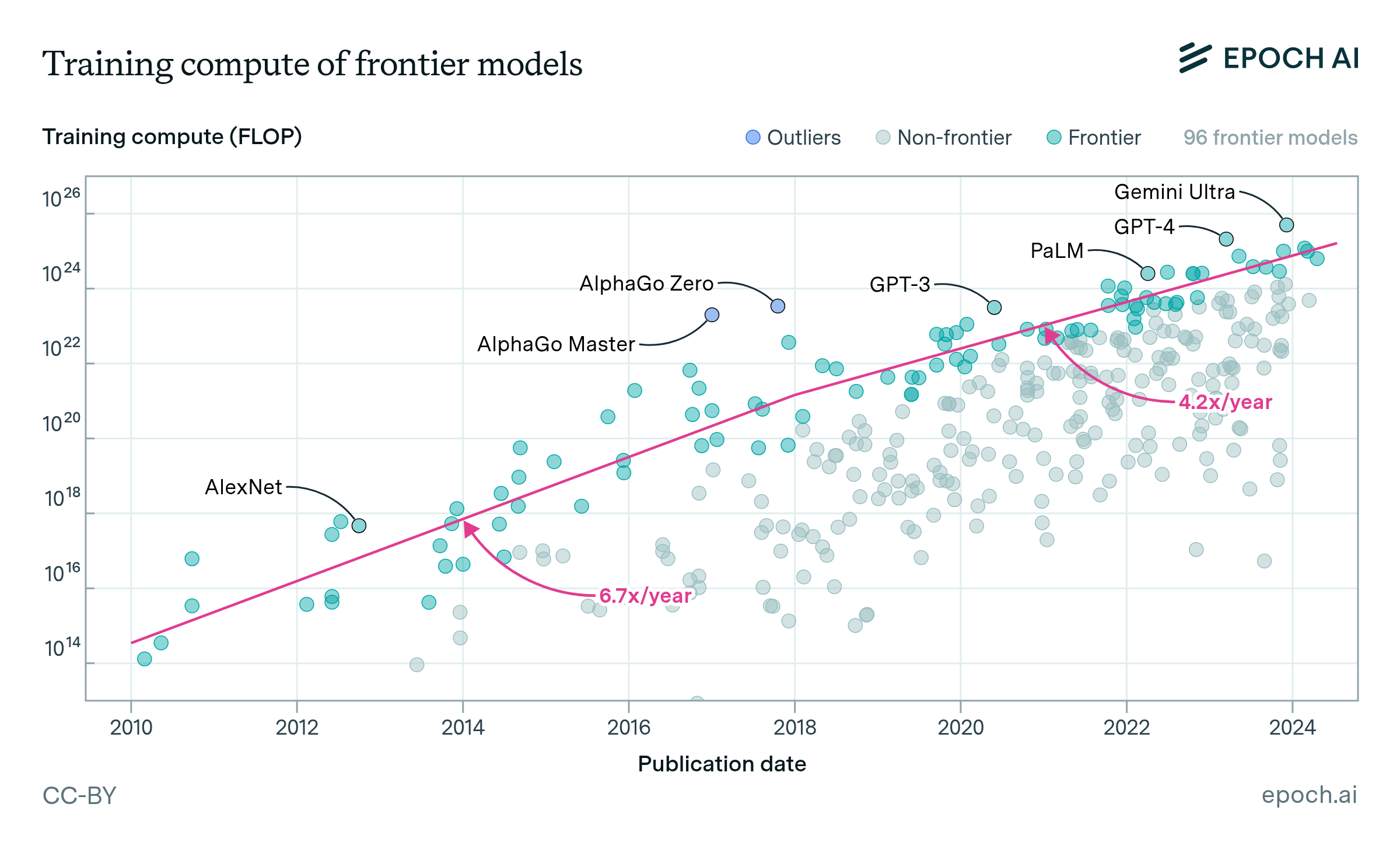 Open full-size figure ↗
Source: Jaime Sevilla, Edu Roldán, Epoch AI (2024-05-28). CC BY 4.0. Original figure, unmodified.
His infrastructure forecast put a roughly one-gigawatt cluster, costing tens of billions of dollars, in the 2026 column. The value of the exercise was to make the physical implications visible: a model-development trajectory also implies factories, power equipment, financing, and construction schedules. Today, Epoch AI’s June 2026 estimate for Colossus 2 puts the site at 946 MW of IT power and a capital cost of $35.8 billion. The scale of the buildout is remarkably close to that once-extraordinary projection.
How the forecasts look in November 2026
| 2024 scenario | Dated evidence | My reading |
|---|---|---|
| Around 2026: ~1 million H100 equivalents, ~1 GW, tens of billions of dollars | Epoch’s June 15, 2026 estimates for Colossus 2: 1.112 million H100 equivalents, 946 MW of IT power, $35.8 billion capital cost. | Close to the forecast’s scale. These are estimated site capacities, not a measured training run. IT power excludes overhead included in the original scenario, so the power figures are not directly interchangeable. |
| Around 2026: a $100 billion AI annual revenue run rate for a company such as Microsoft or Google was described as plausible | Microsoft, April 29, 2026: its AI business had surpassed $37 billion ARR. | Rapid growth, but this disclosure does not establish $100 billion. It is an April snapshot, not a November reading or a full-year verdict; Microsoft’s AI-business definition may also differ from his scenario. |
| Around 2028: an individual training cluster of ~10 GW | The forecast date is still ahead of this November 3, 2026 review. | Too early to score. A multiyear infrastructure announcement does not establish an operating individual cluster. |
I find the scale of the 2026 buildout more persuasive evidence for his framework than treating every later milestone as either inevitable or already disproved.
The intelligence ladder has more than one step
“Unhobbling” is an evocative word. The image is of removing a restraint from a horse rather than breeding a faster one. For models, the practical questions include whether they can use tools, retain relevant context, inspect their own results, and recover when a step fails.
This is why the surrounding engineering matters. A model’s answer in one exchange does not tell us everything about its usefulness inside a well-designed workflow. Compute and algorithmic efficiency can sometimes be compared on a fixed target. Tool use, memory, and reliability (Agent Harness)are harder to compress into a single scale, however, there're surprisingly good progress in Computer Use and Browser Use in 2026.
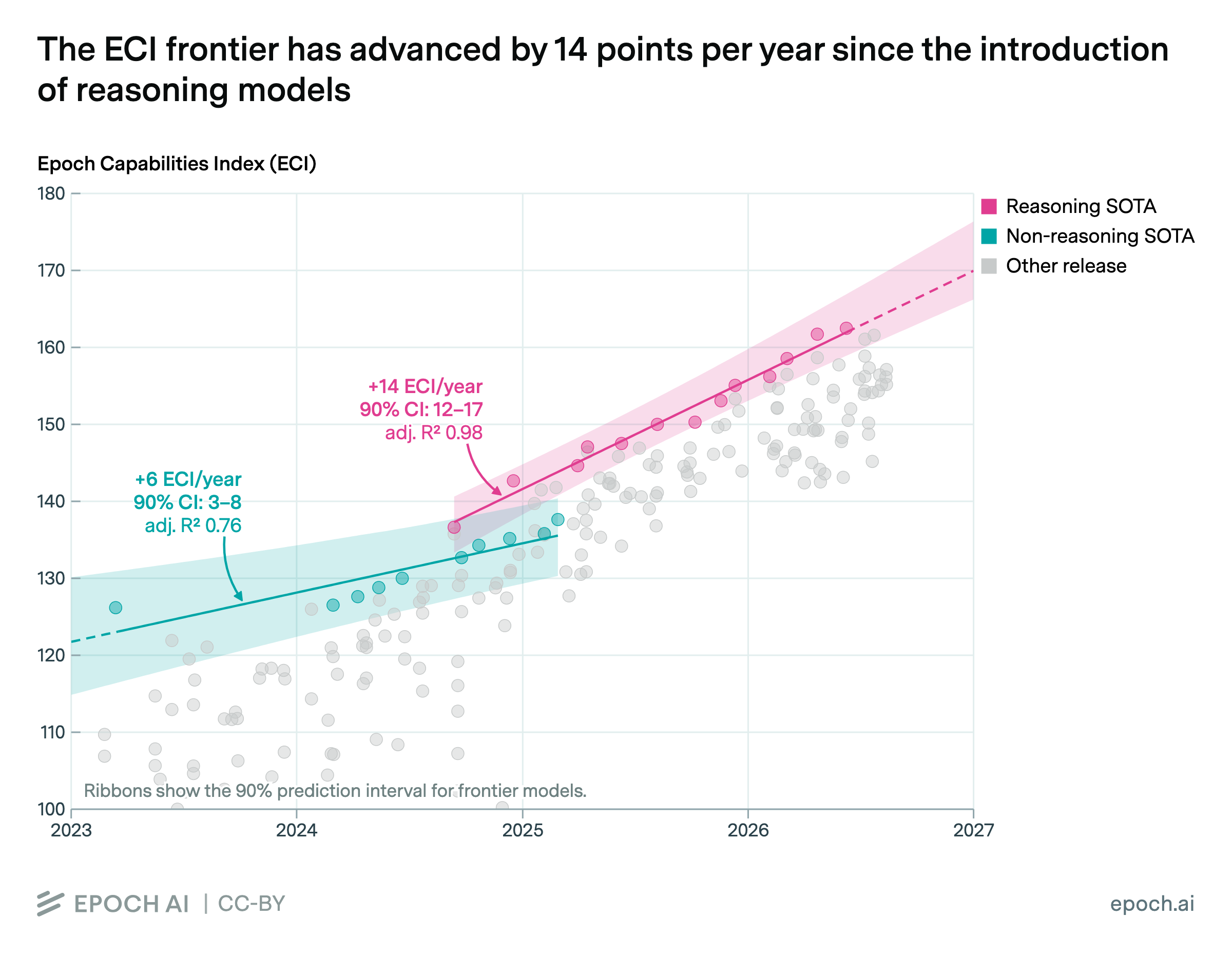 Open full-size figure ↗
Source: Alexander Barry, Epoch AI (2026-09-01). CC BY 4.0. Original figure, unmodified.
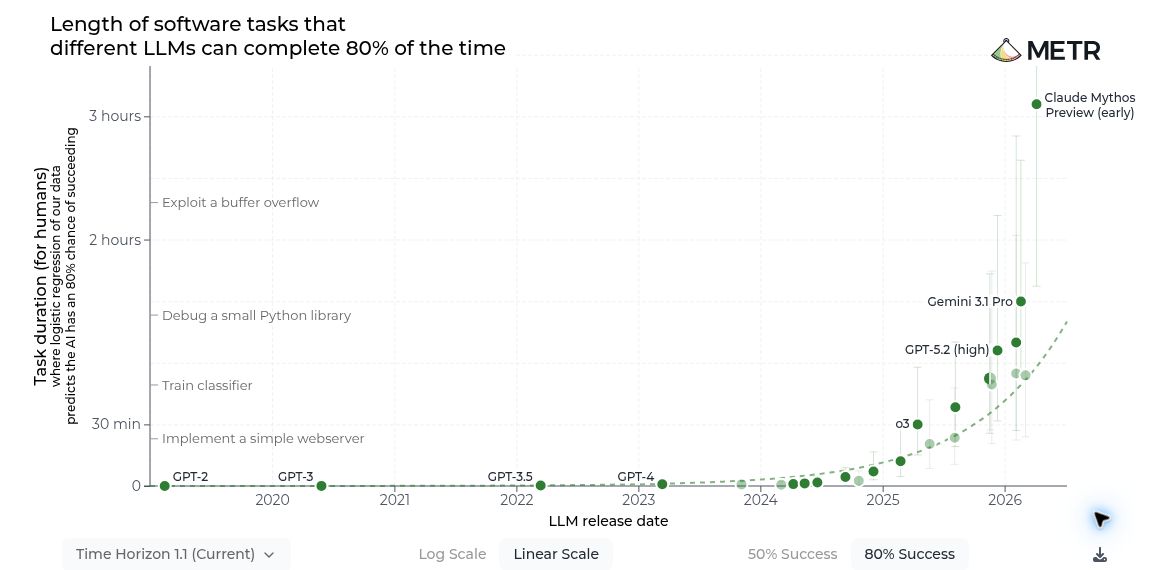 Open full-size figure ↗
Source: METR, Time Horizon 1.1 (page last updated September 8, 2026). Original interactive chart captured with 80% Success and Linear Scale selected.
Inference economics deserve more attention
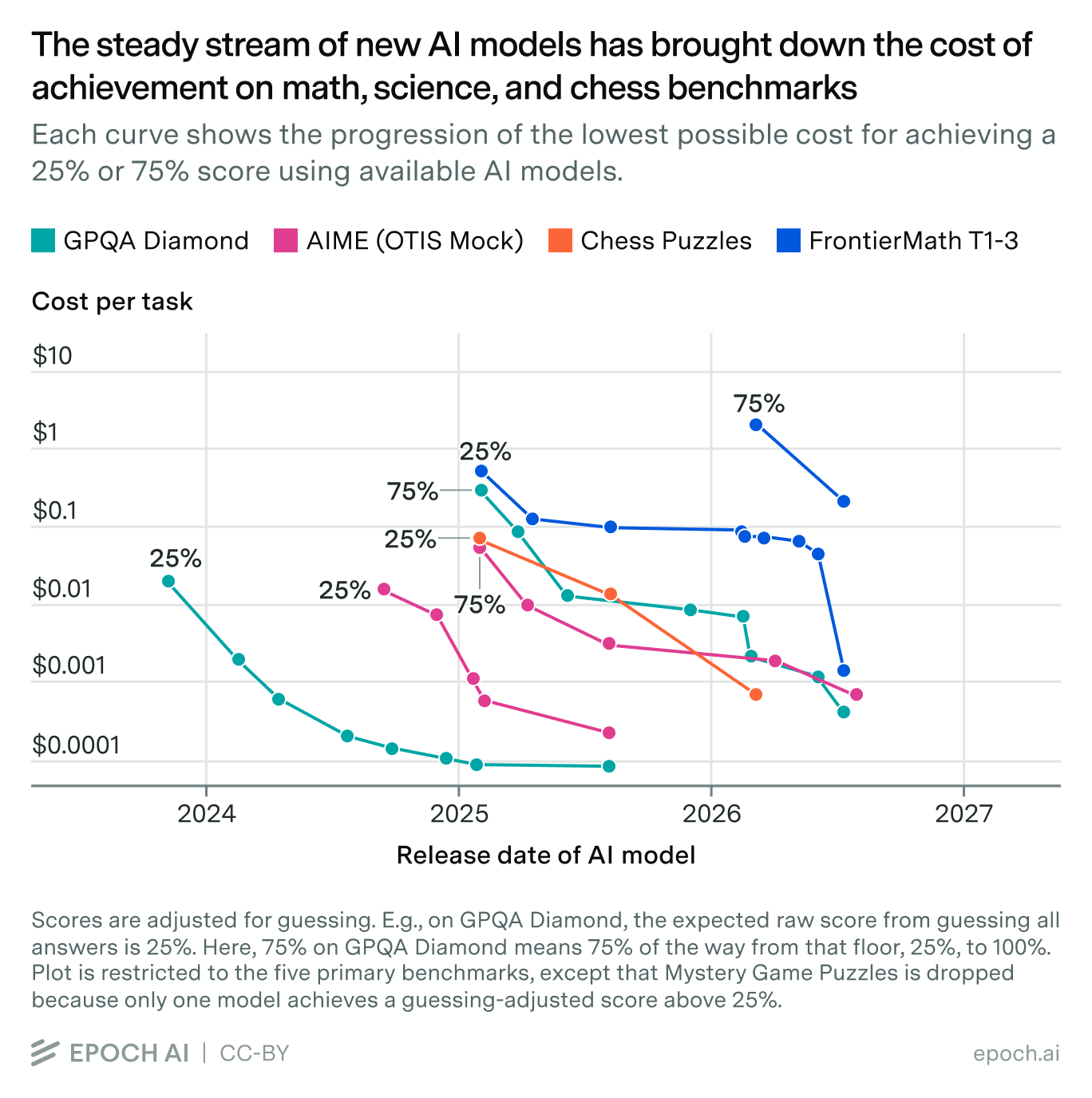
Epoch’s September 2026 analysis estimates that the price of reaching a fixed performance level across its studied benchmarks fell by roughly thirteen times per year over its observation period. The rates differ by domain and by how recently a performance level became available. This is strong evidence of rapid cost improvement. While agent workflow is no guarantee gets cheaper if the business owner + model provider doesn't effectively route model.
 Open full-size figure ↗
Source: Luke Emberson, David Roodman, Epoch AI (2026-09-22). CC BY 4.0. Original figure, unmodified.
For a business, the interesting question is concrete: can this task already be done well enough, and what does an acceptable completed result cost?
I would distinguish tasks that already meet the required quality threshold from experiments that might become practical as costs fall. The second category deserves a place on the roadmap rather than being dismissed after one expensive trial. But it needs a definition of success and a budget, not just enthusiasm about the next model.
This suggests an opportunity for specialized infrastructure providers (fireworks, .etc): understand task complexity well enough to route work to an appropriate model and level of effort. The most capable model is not automatically the best economic choice for every step.
Still, inference cost is only part of the bill. Retries, integration into enterprise, and human supervision can remain expensive. The relevant unit is the cost of a verified outcome. I expect cheaper inference to expand what becomes practical.
What would the revolution look like in GDP?
A question remains: will cheaper intelligence mostly reduce the cost of existing work, or create demand for genuinely new activity?
That question needs a careful distinction. Nominal GDP measures output at current prices. Real GDP adjusts for price changes. So falling AI prices cannot, by themselves, explain why real growth would remain ordinary despite an extraordinary increase in productive capability.
The better questions concern adoption, the kinds of output being created, how quality changes are measured, and who captures the gains. Cheaper services could benefit users without proportionately increasing the revenue of the companies providing them. They could also make entirely new uses worthwhile. These are different economic outcomes, and a capability benchmark cannot tell us which will dominate.
I’m sympathetic to SemiAnalysis’s idea of “dark output”: useful work created by AI may arrive before our economic measures can properly capture it. But I’m less convinced that AI has already penetrated the economy as deeply as the excitement suggests. Tools like Claude Code are visible in my corner of technology, but that is still a narrow window into how most people work.
I’m looking forward to wider, more effective adoption. When it comes, I expect the economic changes to be uneven, but not necessarily slow. As more tasks cross the threshold from an impressive demonstration to a reliable, affordable outcome, changes that once looked gradual may become hard to miss.
References
Sources used in this essay. Links also appear beside the claims they support.
- Leopold Aschenbrenner (2024) — From GPT-4 to AGI: Counting the OOMs
- Leopold Aschenbrenner (2024) — Racing to the Trillion-Dollar Cluster
- METR — Time Horizons
- Luke Emberson and David Roodman (2026) — The Plunging Price of Thought
- Leopold Aschenbrenner (2024) — From AGI to Superintelligence
- Bureau of Economic Analysis — What to Know About GDP
- Leopold Aschenbrenner (2024) — The Free World Must Prevail
- DeepSeek-AI (2024) — DeepSeek-V3 Technical Report
- Training compute of frontier models — Jaime Sevilla, Edu Roldán, Epoch AI, 2024-05-28. Figure 1; CC BY 4.0.
- The ECI frontier has advanced by 14 points per year since the introduction of reasoning models — Alexander Barry, Epoch AI, 2026-09-01. Figure 2; CC BY 4.0.
- The falling cost of fixed benchmark performance — Luke Emberson, David Roodman, Epoch AI, 2026-09-22. Figure 3; CC BY 4.0.
- Epoch AI — Colossus 2. Updated July 30, 2026; June 15 capacity estimates used here.
- Microsoft — FY2026 Third Quarter Earnings Conference Call, April 29, 2026.
- SemiAnalysis — AI Dark Output